Mobile Signal Boosters from Litenet Ltd
Home
Sectors
  • Car Dealerships
  • Factories & Manufacturing
  • Hotels & Hospitality
  • Care Homes
  • Warehouses & Distribution
  • Offices
  • Underground Areas
Mobile Signal
  • Signal Surveys
  • How it works
Knowledge Centre
  • About Us
  • Blogs
  • UK Mobile Networks
Get a Survey
Mobile Signal Boosters from Litenet Ltd
Home
Sectors
  • Car Dealerships
  • Factories & Manufacturing
  • Hotels & Hospitality
  • Care Homes
  • Warehouses & Distribution
  • Offices
  • Underground Areas
Mobile Signal
  • Signal Surveys
  • How it works
Knowledge Centre
  • About Us
  • Blogs
  • UK Mobile Networks
Get a Survey
More
  • Home
  • Sectors
    • Car Dealerships
    • Factories & Manufacturing
    • Hotels & Hospitality
    • Care Homes
    • Warehouses & Distribution
    • Offices
    • Underground Areas
  • Mobile Signal
    • Signal Surveys
    • How it works
  • Knowledge Centre
    • About Us
    • Blogs
    • UK Mobile Networks
  • Get a Survey

  • Home
  • Sectors
    • Car Dealerships
    • Factories & Manufacturing
    • Hotels & Hospitality
    • Care Homes
    • Warehouses & Distribution
    • Offices
    • Underground Areas
  • Mobile Signal
    • Signal Surveys
    • How it works
  • Knowledge Centre
    • About Us
    • Blogs
    • UK Mobile Networks
  • Get a Survey
Sleek modern smartphone on a colorful gradient surface.

UK Mobile Networks Explained: EE, Vodafone, Three and O2

There are dozens of mobile brands available in the UK, which can give the impression that we have dozens of mobile networks. We don't.


Strap yourselves in, this is a big topic!

The Big Four
Well, three actually...

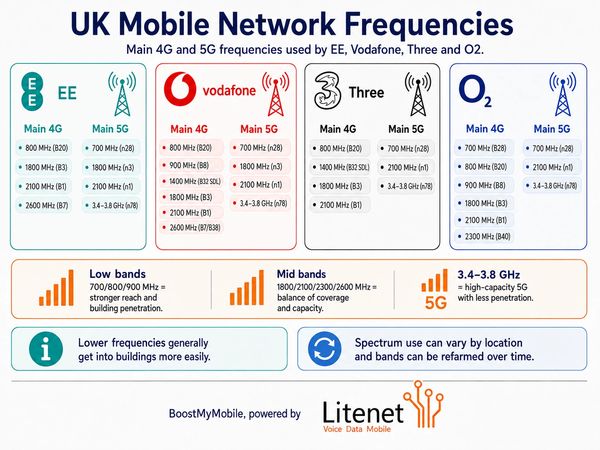
Behind almost every conventional UK mobile SIM sits one of four familiar radio networks: EE, Vodafone, Three or O2. Since Vodafone and Three completed their merger in 2025 there are technically only three major network groups, with Vodafone and Three now coming together under VodafoneThree, although both remain very familiar customer-facing brands.


This matters when we are trying to improve mobile signal inside a building.


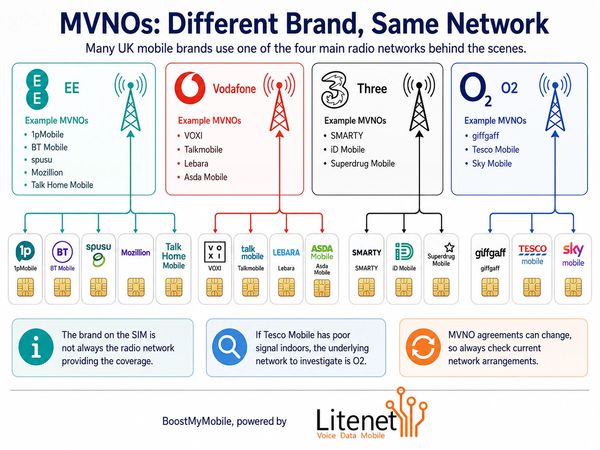
If your company mobiles are with Tesco Mobile, for example, the radio signal reaching the building is coming from O2. If your staff use iD Mobile, we are interested in Three. A VOXI phone leads us back to Vodafone. The name on the bill and the network providing the radio coverage are not always the same thing.


There is another complication, because each network uses several different frequencies for 4G and 5G. Those frequencies behave differently, particularly when asked to travel through modern glass, concrete, insulation, steel cladding and all the other things architects quite reasonably use to stop the outside getting inside.


Unfortunately, radio waves were never invited to the design meeting.

Why do mobile frequencies matter?

Mobile phone signal is radio. As with most things involving radio, frequency matters.


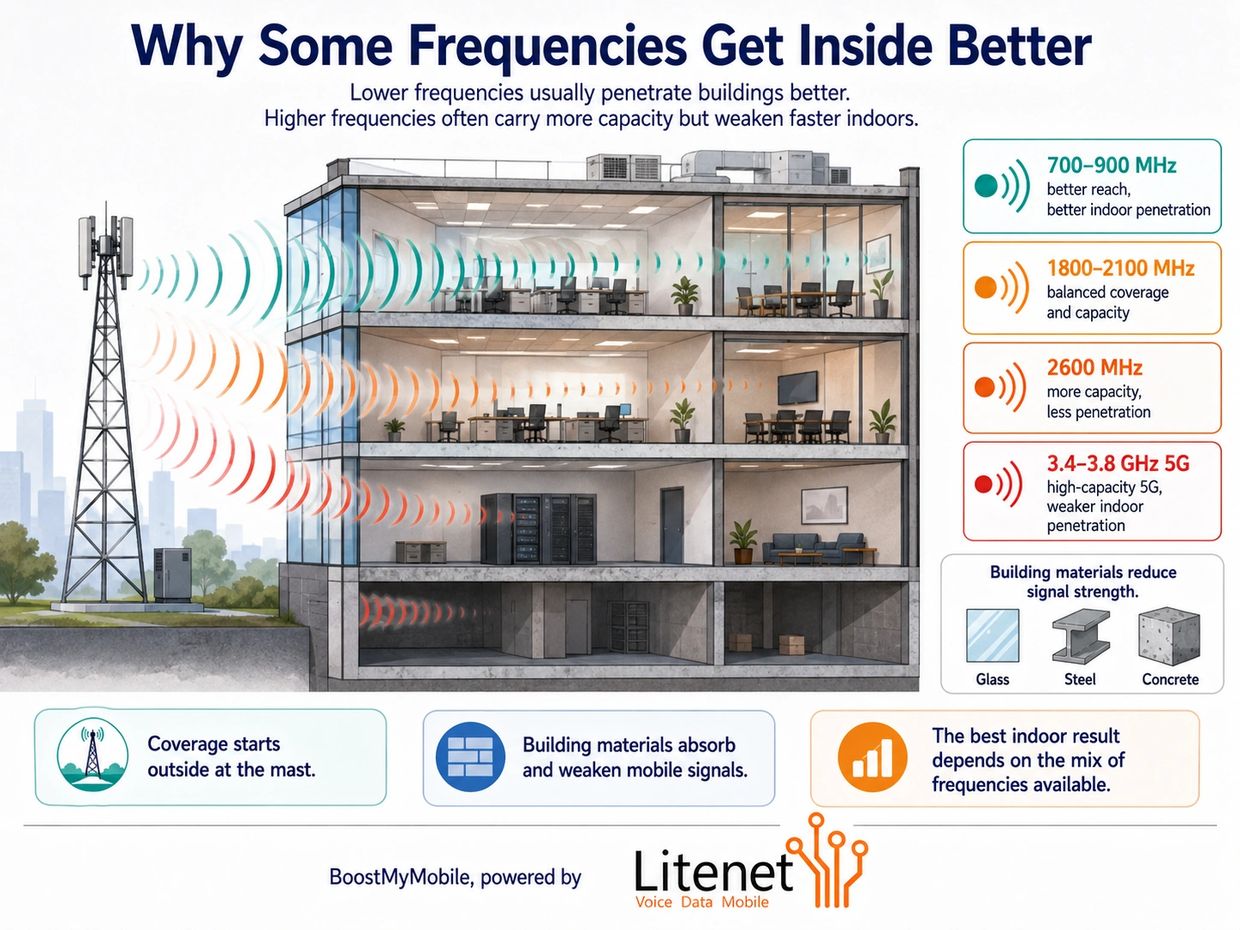
Lower-frequency signals such as 700MHz, 800MHz and 900MHz generally travel further and penetrate buildings more successfully. Higher frequencies can provide much more capacity and faster data speeds, although they tend to find walls, coated glass and building materials considerably less accommodating.


That becomes particularly important with 5G.


There is no single "5G frequency". A phone receiving 5G at around 700MHz is dealing with a very different RF environment from one receiving 5G at 3.5GHz. Both can legitimately display a 5G symbol on the screen, while their ability to reach the middle of a large office, warehouse or factory can be very different.


This is one reason why looking at a network coverage map only tells part of the story. A map may show excellent 5G coverage outside your building. The signal still has to get inside.
Which UK mobile network does my provider use?

A Mobile Virtual Network Operator, usually shortened to MVNO, sells mobile services without operating its own nationwide radio network. Instead, it uses the infrastructure of one of the main networks.


Some of the better-known UK examples include brands such as Smarty Mobile, Lebara, GiffGaff, Tesco Mobile, BT Mobile and more.


MVNO agreements do change from time to time, so the list above is intended as a practical guide rather than a promise carved into a particularly large stone tablet. If we are surveying a building, we identify the network and the actual radio signals present rather than relying purely on the brand printed on a SIM card.


There can also be differences between an MVNO and the main network in areas such as Wi-Fi Calling, VoLTE, 5G access, traffic management and roaming. From an in-building RF perspective, however, knowing the underlying network gives us the important starting point.

EE

EE Mobile Signal and Frequencies

EE has one of the largest spectrum portfolios in the UK and uses a mixture of low, mid and higher-frequency spectrum to provide coverage and capacity.


Its spectrum includes frequencies around 700MHz, 800MHz, 1800MHz, 2100MHz, 2600MHz and the 3.4–3.8GHz range used extensively for 5G.


For commercial buildings, this mixture is important.

EE 4G and 5G frequency guide

Main 4G frequencies

800 MHz — Band 20
Useful low-band coverage with good indoor penetration.


1800 MHz — Band 3
One of EE’s main 4G bands, balancing coverage and capacity.


2100 MHz — Band 1
Formerly heavily used for 3G and now increasingly reused for 4G and 5G.


2600 MHz — Band 7
Higher-capacity spectrum, commonly used in busier areas.


Main 5G frequencies

700 MHz — n28
Low-frequency 5G with good range and better building penetration.


1800 MHz — n3
Can be used for 5G as spectrum is refarmed.


2100 MHz — n1
Another band increasingly available for 5G following the 3G switch-off.


3.4–3.8 GHz — n78
EE’s main high-capacity 5G spectrum. Excellent for speed and capacity, although it penetrates buildings less effectively than lower frequencies.

EE switched off its 3G service during 2024, allowing spectrum previously occupied by older technology to be reused more efficiently for 4G and 5G.


That process is known as spectrum refarming, and it is worth understanding because mobile frequency allocations are increasingly flexible. An operator having a licence for a particular piece of spectrum does not mean every mast in the country is transmitting the same technology on it.


The network configuration in Buckingham can be different from Birmingham, Bristol or Brentford.

That is why an RF survey looks at what is actually arriving at the property.

EE MVNOs

If your company mobiles are supplied by an EE-based provider such as 1pMobile, BT Mobile, spusu or Mozillion, an EE coverage problem is still relevant to you.

For a business with hundreds of company mobiles this can become particularly important. Changing mobile provider may change the commercial arrangement without necessarily changing the RF situation if the new provider ultimately uses the same host network.


We therefore establish the underlying network before we start talking about equipment.

Vodafone

Vodafone Mobile Signal and Frequencies

Vodafone has operated a UK mobile network for a very long time. In fact, the UK's first commercial mobile phone call was made over the Vodafone network on 1 January 1985.


Thankfully, both mobile phones and hairstyles have improved since then.


Vodafone's network has developed through several generations of technology and today uses spectrum including 800MHz, 900MHz, 1400MHz, 1800MHz, 2100MHz, 2600MHz and the 3.4–3.8GHz 5G range.

Vodafone 4G and 5G frequency guide

Main 4G frequencies

800 MHz — Band 20
Important low-band 4G coverage with strong indoor characteristics.


900 MHz — Band 8
Very useful low-frequency spectrum with excellent range and building penetration.


1400 MHz — Band 32
Supplementary downlink spectrum used to increase capacity.


1800 MHz — Band 3
Mid-band spectrum providing a useful balance of coverage and capacity.


2100 MHz — Band 1
Historically associated with 3G and increasingly reused for newer technologies.


2600 MHz — Bands 7 and 38
Higher-capacity spectrum used where more bandwidth is needed.


Main 5G frequencies

700 MHz — n28
Low-band 5G with good coverage and indoor penetration.


1800 MHz — n3
Can support 5G as Vodafone continues to refarm spectrum.


2100 MHz — n1
Also available for 5G deployment.


3.4–3.8 GHz — n78
High-capacity 5G spectrum used for faster data and greater network capacity.


VodafoneThree note

Vodafone and Three are now part of VodafoneThree. Their networks and spectrum are progressively being integrated, so the traditional Vodafone and Three frequency lists are becoming less separate over time.

The lower-frequency holdings are particularly interesting when we are looking at indoor coverage. An 800MHz or 900MHz donor signal may remain usable in circumstances where a much higher-frequency signal has already had a fairly serious disagreement with the glazing.


Of course, frequency is only one variable. Signal strength, interference, network load, antenna orientation, surrounding buildings and the construction of the property all play their part.


Which is precisely why we measure it.

Vodafone MVNOs

Well-known mobile brands using Vodafone include VOXI, Talkmobile, Lebara and Asda Mobile.


VOXI and Talkmobile sit particularly close to Vodafone itself, while other MVNO arrangements are commercial wholesale relationships.


For somebody trying to solve poor mobile reception at work, the important point is straightforward. A member of staff saying, "I'm on Lebara" gives us useful information, but during the survey we are ultimately interested in the Vodafone radio network behind it.

Three

Vodafone and Three are now VodafoneThree

There is a fairly important development to deal with before moving on to Three.


Vodafone UK and Three UK completed their merger in May 2025, creating VodafoneThree.


The two brands have continued to exist, so somebody can still quite happily be a Vodafone customer while the person sitting next to them is a Three customer. Behind the scenes, however, the networks are increasingly being brought together.


This has moved beyond simply sharing a company letterhead.


By May 2026, VodafoneThree said it had deployed its integrated network-sharing technology across more than 10,000 sites, allowing millions of Vodafone and Three customers to connect automatically to the best available coverage from either side of the combined network.

It has also started making the combined spectrum holdings of the two companies available across the network, significantly increasing 4G and 5G capacity in some areas.


For anybody involved in indoor mobile coverage, this is worth watching closely.


Historically, we could discuss the Vodafone and Three spectrum portfolios as two very separate things. Increasingly we have to consider the combined VodafoneThree radio network, while remembering that integration is a programme taking place across thousands of sites rather than a switch somebody flicked at midnight on merger day.


There is another important qualification for MVNO customers. VodafoneThree has confirmed network-sharing benefits across its own principal brands, including Vodafone, Three, VOXI, Talkmobile and SMARTY. We should not automatically assume that every independent MVNO using Vodafone or Three receives identical access to every element of the combined network.


Networks are complicated. That is why people employ RF engineers rather than asking Dave from Accounts to stand by the window and count the bars on his iPhone.

Three Mobile Signal and Frequencies

Three entered the UK market much later than Vodafone, launching in 2003 as a network built around 3G.


That history explains some of the differences in Three's spectrum portfolio. Over time it has accumulated significant amounts of mid-band spectrum, particularly in the frequencies that have become extremely valuable for 5G.


Its spectrum has historically included 800MHz, 1400MHz, 1800MHz, 2100MHz, 3.4GHz and substantial holdings across the wider 3.4–3.8GHz area.


Following the creation of VodafoneThree, those resources are progressively being combined with Vodafone's.

Three 4G and 5G frequency guide

Main 4G frequencies

800 MHz — Band 20
Low-frequency 4G coverage with useful indoor penetration.


1400 MHz — Band 32
Supplementary downlink spectrum used to add capacity.


1800 MHz — Band 3
An important part of Three’s 4G network.


2100 MHz — Band 1
Historically central to Three’s 3G network and increasingly reusable for 4G and 5G.


Main 5G frequencies

700 MHz — n28
Low-band coverage spectrum available within the combined VodafoneThree portfolio.


2100 MHz — n1
Can be used for 5G as older spectrum is refarmed.


3.4–3.8 GHz — n78
A major part of Three’s 5G network and one of the reasons it can deliver very high 5G speeds where coverage is strong.


VodafoneThree note

Following the merger, Three customers are increasingly benefiting from VodafoneThree’s combined network and spectrum. Integration is ongoing and varies by location.

Three's large amount of C-band spectrum has historically been one of the reasons it has been able to offer very high 5G speeds in suitable locations.


There is a trade-off.


The 3.4–3.8GHz frequencies used for much of the UK's high-capacity 5G deployment do not travel through buildings as readily as lower-frequency mobile signals. A Three user can therefore achieve spectacular 5G speeds in the car park and discover a rather less spectacular experience after walking through the front door.


We see this sort of behaviour regularly in modern commercial buildings.


It is particularly relevant in warehouses, factories and recently constructed offices, where insulated cladding, Low-E glass and modern building materials can produce a substantial difference between the signal outside and the coverage available inside.

Three MVNOs

The best-known Three-based brands include SMARTY, iD Mobile and Superdrug Mobile.


SMARTY forms part of the wider Three/VodafoneThree family and is specifically included in some of the network integration improvements. Independent MVNO arrangements can differ, so again we establish exactly what is being used during the survey.


For businesses with a mixture of Three, SMARTY and iD Mobile users, this distinction can become surprisingly important.

O2

O2 Mobile Signal and Frequencies

O2 is now part of Virgin Media O2, usually shortened to VMO2, and has one of the most varied spectrum portfolios of the UK networks.


Its holdings include frequencies around 700MHz, 800MHz, 900MHz, 1800MHz, 2100MHz, 2300MHz and the 3.4–3.8GHz range, giving it access to a useful mixture of coverage and capacity spectrum.


O2 has also been going through the same wider industry process of retiring older technology and reusing the frequencies for 4G and 5G.

O2 4G and 5G frequency guide

Main 4G frequencies

700 MHz — Band 28
Low-frequency spectrum with excellent range and building penetration.


800 MHz — Band 20
A major O2 4G coverage layer with strong indoor characteristics.


900 MHz — Band 8
Very useful low-band spectrum for coverage and penetration.


1800 MHz — Band 3
Additional 4G capacity.


2100 MHz — Band 1
Formerly heavily used for 3G and increasingly refarmed for newer technologies.


2300 MHz — Band 40
A distinctive O2 capacity band used to provide additional bandwidth in busy areas.


Main 5G frequencies

700 MHz — n28
Low-band 5G offering better coverage and penetration than higher-frequency 5G.


2100 MHz — n1
Can be used for 5G following refarming.


3.4–3.8 GHz — n78
O2’s main high-capacity 5G spectrum, providing strong speeds and capacity but weaker building penetration than lower bands.

The 2300MHz holding is particularly distinctive, because O2 is the main UK national mobile operator with a substantial allocation in this band.


As with Vodafone, its 800MHz and 900MHz spectrum also provides useful low-frequency coverage characteristics.


That does not magically guarantee good indoor O2 coverage. A good signal outside can still be attenuated heavily by the building envelope, and the available frequency mix varies between locations.


We have surveyed plenty of buildings where one operator performs brilliantly and another barely survives the journey through reception.


There is no contradiction there. They may be transmitting from different masts, at different powers, using different frequencies and approaching the building from completely different directions.

O2 MVNOs

Several very large UK mobile brands use the O2 network, including giffgaff, Tesco Mobile and Sky Mobile.


That can make O2 especially important when surveying a workplace.


A company may officially use one mobile provider while staff with personal phones bring several other brands into the building. A dealership, hotel, office or factory can easily have customers, employees and visitors using all four networks during the course of a normal day.


Where reliable mobile coverage matters to everybody in the building, designing around a single company SIM estate may only solve part of the problem.

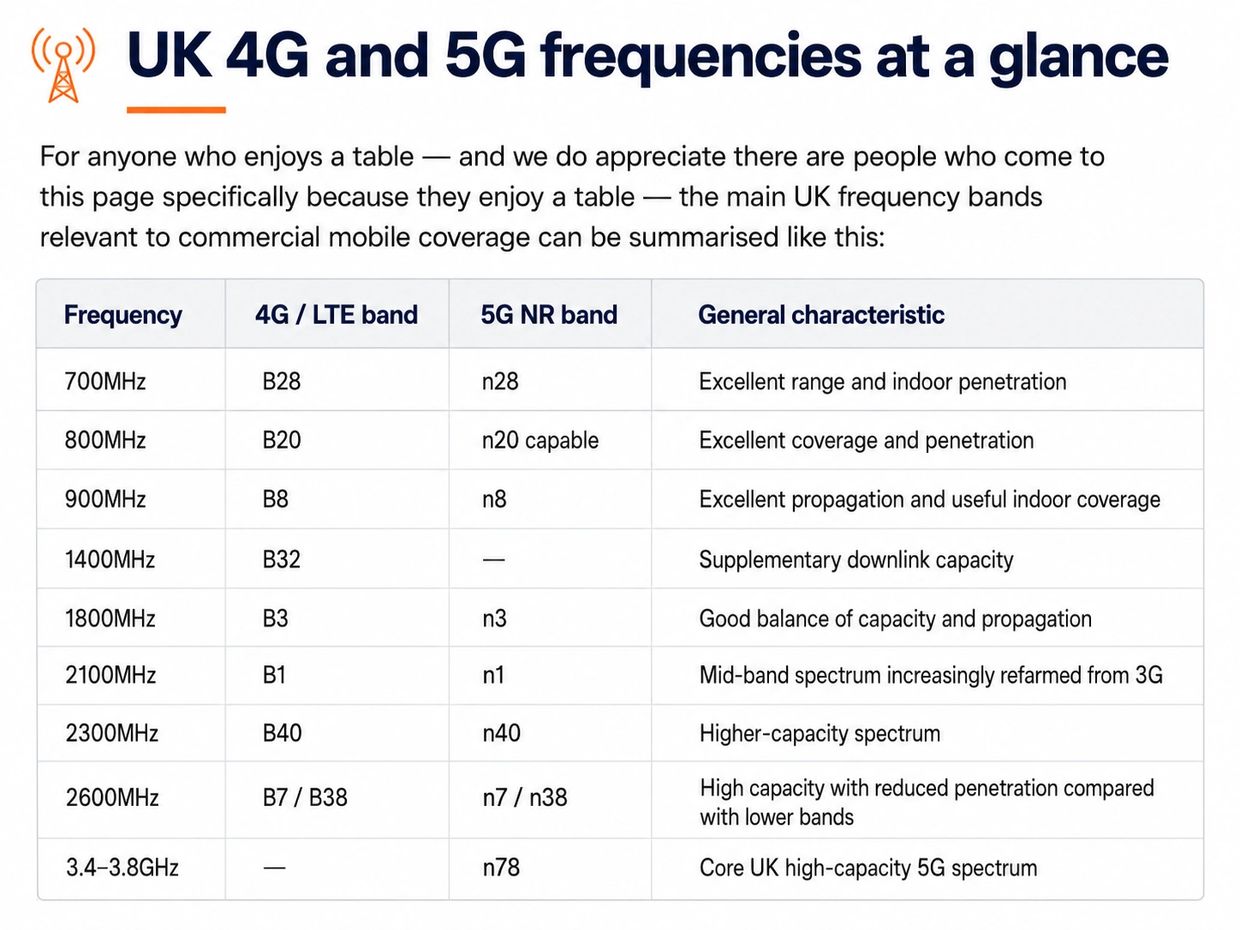
UK 4G and 5G frequencies at a glance

The main UK mobile bands include 700MHz, 800MHz, 900MHz, 1400MHz, 1800MHz, 2100MHz, 2300MHz, 2600MHz and the 3.4–3.8GHz range. Lower bands generally offer better propagation and building penetration, while higher bands provide greater capacity. 


The UK has also awarded spectrum at much higher frequencies, including 26GHz and 40GHz, for future high-capacity 5G services. Those frequencies have very different propagation characteristics again and are currently much less relevant to the typical commercial mobile signal problem we are called to investigate.

Does a lower frequency always mean better mobile signal?

No, because mobile networks stubbornly refuse to make life that simple.


Lower frequencies generally have better propagation characteristics, but usable mobile service depends on much more than frequency alone.


A strong, clean 1800MHz signal can be far more useful than a weak and heavily interfered-with 800MHz signal. A nearby 3.5GHz 5G site may produce excellent indoor performance in one building while disappearing rapidly inside another. Even two apparently identical units on the same industrial estate can behave differently because of their orientation to the mast and the materials used in their construction.


During a proper mobile signal survey we look at the actual RF environment. That includes signal strength, signal quality, frequency bands, available networks, donor locations, interference and the way the signal changes as we move through the property.


The bars on the phone are allowed to come along for the ride, but they are not in charge.

Can one mobile signal system cover several networks?

Yes, where the survey, available donor signals and equipment support it.


Some commercial installations are designed for a single network because an organisation has a large corporate mobile estate with one provider. Others need multi-network coverage because the building is used by customers, visitors, contractors and employees carrying phones across EE, Vodafone, Three and O2.


The correct design depends on the building and what the customer is trying to achieve.


For example, an office occupied by 200 employees all using company-issued EE mobiles has a very different requirement from a hotel, car dealership or visitor attraction where members of the public arrive carrying every network imaginable.


We establish that at the beginning rather than discovering it shortly after the installation has finished, which is traditionally considered the less convenient time.

4G, 5G and the building itself
Mobile networks continue to evolve rapidly, although one part of the problem remains stubbornly physical.

Buildings block radio signals.


Modern energy-efficient glass can contain metallic coatings. Insulated wall panels may be faced with metal. Reinforced concrete contains, unsurprisingly, reinforcement. Warehouses frequently resemble enormous steel boxes, which is excellent if your objective is to keep the weather outside and rather less useful if you would also like Vodafone to come in.


This means the solution to poor indoor mobile coverage starts with understanding the building and the external radio environment.


We survey outside first to establish what each network is actually delivering to the site. We then measure inside the building to understand where the losses occur and which parts of the property require improvement.


From there we can design a compliant in-building mobile coverage system around the signals that genuinely exist.

Do I need to know which frequency my phone is using?

Thankfully, no.


If you are curious, modern phones and specialist applications can reveal a surprising amount about the cellular connection. For a commercial installation, however, there is little benefit in spending Thursday afternoon wandering around the warehouse trying to decide whether Band 20 looks happier than Band 3.


That is our job.


A professional survey identifies the networks, bands, signal levels and donor options available at the building and gives us the information needed to design the system properly.


If you already know that EE disappears in the boardroom, Vodafone only works next to the loading bay and somebody from Sales has discovered that O2 works perfectly provided they stand on one particular chair, that is useful too.


We have heard stranger fault descriptions.
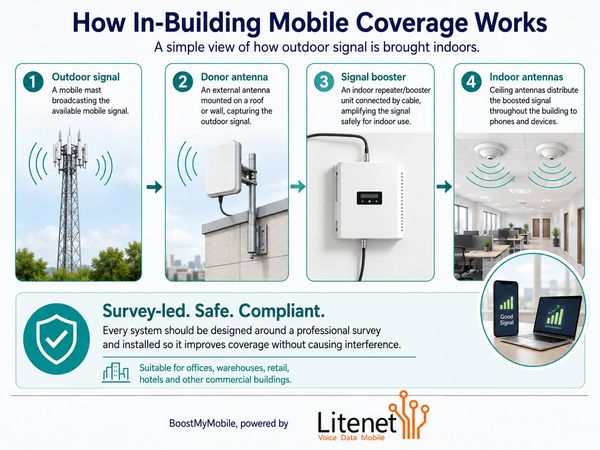
Need better EE, Vodafone, Three or O2 coverage inside your building?

BoostMyMobile is Litenet's specialist commercial mobile coverage service.


We survey, design and install Ofcom-compliant indoor mobile signal solutions for businesses throughout the UK, covering offices, factories, warehouses, car dealerships, hotels and other commercial buildings.


We can investigate problems affecting a single mobile network or design multi-network coverage where the building needs to support staff, customers and visitors across EE, Vodafone, Three and O2.


Every useful installation starts by finding out what is actually happening with the radio signal.


Talk to us about a mobile signal survey

Talk to us

 Written by Chris Thomas, Director of Litenet Ltd. Chris has worked in business telecommunications since 1995, including mobile connectivity, fixed networks and commercial communications systems. 

Frequently Asked Questions

Please reach us at info@litenetuk.com if you cannot find an answer to your question.

The four familiar consumer mobile networks are EE, Vodafone, Three and O2. Vodafone and Three are now owned by the combined VodafoneThree business following their merger in 2025, while both continue to operate as customer-facing brands.


An MVNO, or Mobile Virtual Network Operator, sells mobile services using another company's radio network. Examples include giffgaff on O2, SMARTY on Three, VOXI on Vodafone and 1pMobile on EE.


The underlying radio coverage comes from the host network, although features and service arrangements can differ between providers. These can include 5G availability, VoLTE, Wi-Fi Calling, roaming and traffic-management policies.


For an indoor mobile coverage survey, identifying the underlying host network is therefore important.


Lower-frequency spectrum such as 700MHz, 800MHz and 900MHz generally has better propagation and building penetration than higher-frequency spectrum.

Actual indoor performance still depends on signal strength, signal quality, mast location and the construction of the building.


Many high-capacity 5G services use spectrum around 3.4–3.8GHz. These frequencies can deliver excellent data capacity but suffer greater losses through building materials than lower-frequency signals.


Modern Low-E glass, metal cladding, insulation and reinforced concrete can all contribute to significant indoor attenuation.


Vodafone and Three are progressively integrating their networks following the creation of VodafoneThree. Network-sharing technology has already been deployed across thousands of sites, allowing eligible Vodafone and Three customers to connect automatically to the best available coverage from the combined infrastructure.


The integration is continuing, so the exact radio configuration varies by location.


Commercial systems can be designed for one or several UK mobile networks depending on the equipment, available external signals and requirements of the building.


A survey establishes which networks and frequencies are available and allows the system to be designed around the actual RF conditions at the site.


Certain mobile signal repeater systems can be operated legally in the UK without an individual spectrum licence provided that the equipment and installation comply with the relevant Ofcom licence-exemption requirements.


Commercial systems should be properly surveyed and designed to improve coverage without causing interference to the public mobile networks.


Technical review date: September 2026

Mobile networks, spectrum deployment and MVNO arrangements continue to change. The information on this page is based on current UK spectrum allocations and network information available at the review date. Frequencies and technologies deployed by an operator vary by location.


Copyright © 2026 Litenet Ltd - All Rights Reserved. 

Company registered in the UK:  11868036 

Telephone 01908 794 794

Powered by Litenet Ltd

  • Privacy Policy

This website uses cookies.

We use cookies to analyze website traffic and optimize your website experience. By accepting our use of cookies, your data will be aggregated with all other user data.

DeclineAccept