
Mobile Signal Boosting for Warehouses & Distribution Centres
Poor mobile signal inside a warehouse or distribution centre can affect far more than somebody trying to make a phone call.
Warehouse managers, engineers and supervisors move throughout large buildings. Drivers and contractors arrive using their own mobile networks. Smartphones and tablets can form part of delivery, logistics and authentication processes, while connected equipment may also depend on cellular connectivity.
Unfortunately, warehouses can be some of the most difficult commercial buildings for mobile networks to penetrate.
Steel frames, metal cladding, insulated composite panels, reinforced concrete, high-bay racking and the sheer size of modern logistics buildings can all reduce the mobile signal available inside.
Litenet surveys, designs and installs commercial mobile coverage systems for warehouses and distribution facilities throughout the UK.
Why Warehouses Lose Mobile Signal
A warehouse can have excellent mobile coverage outside and very little usable signal inside.
The building itself is often the reason.
Modern distribution centres are frequently constructed using steel frames, metal roofs and insulated wall panels. These materials can substantially reduce the radio signal entering the property.
Size adds another challenge.
Even where usable signal reaches the perimeter of the building, it may not penetrate far enough into the centre of a large warehouse.
The internal environment can make things more complicated again. High-bay racking, mezzanine floors, stored materials, machinery and changing stock levels can all influence how mobile signal behaves.
The result is often inconsistent coverage.
One loading bay may have perfectly usable mobile service while an aisle a short distance away has almost none.
That is why a warehouse needs to be assessed as an actual radio environment rather than simply looking at the coverage shown for its postcode.
Mobile Connectivity Is Part of the Logistics Operation
People working in logistics tend to be mobile.
Warehouse managers may move between offices, picking areas, loading bays and yards. Maintenance engineers can be working anywhere across a large building.
Supervisors and facilities teams need to remain contactable as they move around the site.
Then there are the people arriving from outside the business.
HGV drivers, couriers, contractors and visitors increasingly rely on smartphones for navigation, delivery instructions, proof of delivery, photographs, authentication, messaging and communication with their own transport office.
Those users may not have access to the warehouse Wi-Fi network — and in many cases there is no reason they should.
Their devices remain dependent on the public mobile network.
Mobile connectivity can also extend beyond people.
Tracking devices, gateways, monitoring equipment and other connected technology may use cellular networks independently of the building's corporate Wi-Fi or fixed data infrastructure.
That means poor indoor mobile coverage can potentially affect people, processes and connected equipment.
For a modern distribution facility, cellular coverage is increasingly part of the communications infrastructure of the building.
We Survey Before We Design
A mobile network's coverage map cannot tell us what is happening in the middle of a large metal-clad warehouse.
We need to measure the actual site.
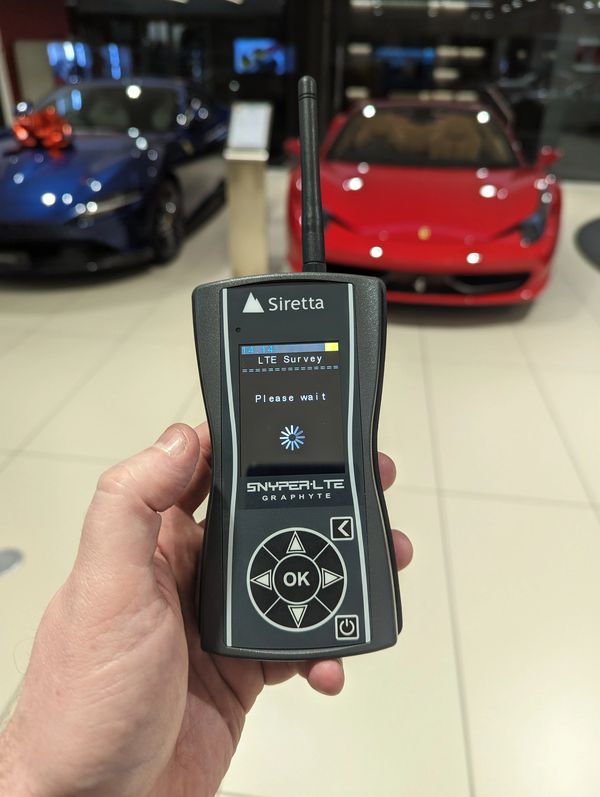
A professional mobile signal survey allows us to assess the donor signal available outside, signal strength and quality inside the building, the networks and frequencies available and where coverage becomes weak or unusable.
We also look at the physical building.
Racking, loading areas, high ceilings, plant, cable routes and potential antenna positions can all influence how a solution should be designed.
Most importantly, we establish where the business actually needs mobile coverage and who or what needs to use it.
A warehouse that primarily needs reliable coverage for company mobiles on one network may require a different solution from a distribution centre that needs coverage for employees, visiting drivers and devices operating across several networks.
The survey gives us the information needed to design around the requirement rather than simply choosing equipment first.
You don't need to know which mobile signal booster you need. That's our job

Designed Around Your Warehouse
Warehouses present practical challenges that need to be considered as part of the system design.
Ceilings may be extremely high and cable routes may extend over considerable distances. Racking, automation and operational equipment can restrict access, while loading areas and external structures may create additional coverage requirements.
The site may also remain operational throughout the installation.
A good design therefore considers both the radio environment and the way the warehouse actually works.
That includes the location of donor antennas, internal coverage antennas, equipment and cabling, together with access requirements and the areas that need coverage.
Depending on the requirement, a system can also be designed around a particular mobile network or multiple networks.
We determine that from the survey and the operational needs of the site rather than forcing the building around a particular product.

New Buildings, Refurbishments and Multi-Site Operations
Poor mobile coverage is sometimes discovered only after a new warehouse has been completed.
The signal may be perfectly good in the car park but disappear as soon as somebody enters the building.
Modern insulated building envelopes, metal construction and energy-efficient materials can be extremely effective at reducing mobile radio signals.
Where possible, mobile coverage is therefore worth considering alongside Wi-Fi, structured cabling and other communications infrastructure during the design or refurbishment of a logistics facility.
Planning earlier can make antenna positions, equipment locations and cable routes easier to incorporate cleanly into the finished building.
The same principles apply to organisations operating several warehouses or distribution centres.
A consistent approach can be used for survey, design, installation and validation across multiple sites — while still recognising that every building will have a different RF environment.
The process can be consistent. The solution should be designed for the individual site.
Installation, Testing and Ofcom Compliance
Closing a warehouse while a mobile coverage system is installed is rarely practical.
Litenet can plan installation around the operation of the site, coordinating access with warehouse, facilities and engineering teams and working around loading activity, automated equipment and other operational constraints.
Where necessary, work can also be scheduled outside normal operating periods.
The complete process can be managed by one team:
Survey. Design. Installation. Commissioning. Testing. Validation. Support.
After commissioning, the mobile environment can be measured again to confirm that coverage has improved in the areas the system was designed to serve.
That gives the business evidence of what has changed rather than relying entirely on the number of bars shown on a phone.
Mobile signal repeaters used in the UK also need to meet the relevant requirements for lawful operation.
Litenet designs commercial mobile coverage systems around equipment appropriate for legal use in the UK and suitable for the individual project.
Ofcom permits certain mobile signal repeaters to be used on a licence-exempt basis provided they meet the relevant technical requirements.
The objective is a properly designed and tested indoor mobile coverage system — not simply the most powerful booster available.